Wednesday, July 27, 2011

Protecting the reefs of the Maldives through education & capacity-building

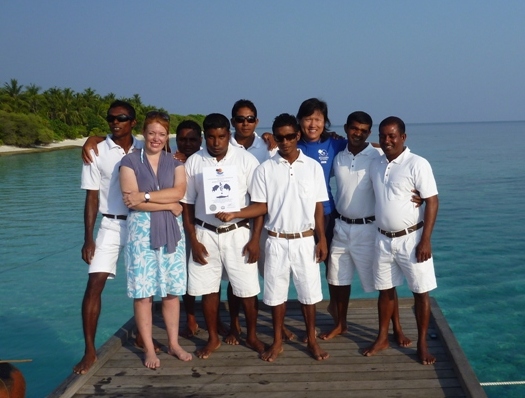
Six Senses Maldives resorts sponsor Biosphere Expeditions $79,000 over four years to:

  • ...survey and monitor remote reefs of the Maldives
  • ...educate and involve local people
  • ...create a scholarship program
  • ...and train and educate local staff

Biosphere Expeditions is working with a large number of partners such as Reef Check (RC), the Marine Conservation Society (MCS), the United Nations Environment Programme (UNEP), the World Conservation Monitoring Centre (WCMC) and the International Coral Reef Action Network (ICRAN), as well as local businesses such as Soneva Resorts Maldives, operators and local communities to ensure its success.  The project is also supported by the Marine Research Centre (Maldives Fisheries Dept.)
 
For more details please visit:


A Beautiful Phenomenon in Soneva Fushi's Lagoon

Thousands of incredibly beautiful blue button “jellyfish” filled our lagoon recently, creating what looked like an enormous bath of blue flowers in the turquoise water.

These blue buttons are not jellyfish at all, and thankfully they do not sting!

Blue buttons are actually what we call hydrozoans which belong to the same animal phylum as the jellyfish - Cnidaria. They are closely related to the “true” jellyfish, box jellyfish, sea anemones and corals and share with them the group’s distinct fea­ture: specialized cells that carry stinging organelles. The blue button (Porpita porpita) however is harmless to humans as the stinging cells are unable to pierce the skin.
Although related to jellyfish, blue buttons are in fact colonial animals that are characterised by the cooperative action of small polyps with different functions; some are responsible for defence, some for feeding, others for reproduction etc. These pelagic colonies cannot actively move/swim but drift on the surface of the open sea, partially using a central disc-shaped float made up of numerous chambers and blue or green tentacles that are used for feeding on microscopic organisms near the water surface. Their colour is usually a dark blue, which is thought to help avoid predation by birds.

Sustainable Tuna


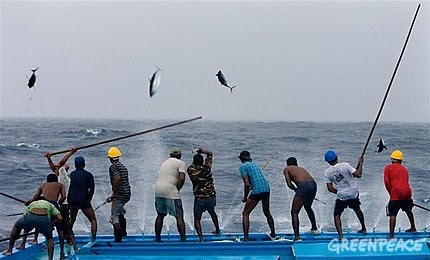
The Maldivian Skipjack Industry, a 100% pole and line process, is the dominant economic fishery activity in the country, and is also recognized as one of the most environmentally sustainable skipjack fisheries in the world supplying many international food chains.

Maldives tuna tins in UK supermarkets
Felivaru was the first tuna cannery in the Maldives, established in 1977. It has been expanding ever since, but still cannot meet the rising international demands for sustainable Maldives tuna as there just is not enough fish. The Maldives pole and line fishery, according to Green Peace, is “one of the best-known examples of a successful coastal state-run tuna fishing operation“. However the fishery is under immense pressure from international purse seiners who target the tuna as they migrate out of Maldives waters. The positioning of high tech fish aggregating devices (FADS) on the edge of Maldives EEZ by international purse seiners is disrupting migration patterns and putting further pressure on Maldives stocks.

Green Peace declares pole and line as a successful and
sustainable fishing method
Since time immemorial, the method of fishing employed in the Maldives has been the pole and line method. Traditionally, the fishermen set out at dawn in search of bait fish, which are caught and kept alive in a specially prepared compartment of the dhoni. Eight or nine men do the actual fishing, using short poles with a line, and hook. It is a highly selective and sustainable fishing method with no bycatch. Net fishing in Maldives is in fact banned, other than for bait fishing in lagoons.

Traditional bait fishing net -the only nets permitted in Maldives
Throwing the live bait to attract the tuna
 Soneva Fushi’s Executive Chef, F&B Coordinator, Purchasing Manager, Marine Biologist and Guest Relations Manager visited the Felivaru Cannery to begin a supply of sustainably sourced, local tuna.  Upon the visit, we were presented with a wealth of sustainable and organic products that they produce in addition to tuna. Our hosts our currently building on this relationship and are looking at purchasing not only sustainable tinned tuna, but also a range of exciting traditional Maldivian products that are fully sustainable and organic.    

Guest Relations Manager Abulhi and Purchasing Manager
Rajesh trying out a whole range of organic products

Executive Chef Bjorn trying Kuhli Roshi
- traditional Maldivian waffles
www.felivaru.com


Tuesday, July 26, 2011

Turtle Rescue

Waste in our oceans is a serious threat to marine life, with plastic bags and drifting nets of particular impact to turtles.  Drifting nets are called 'ghost nets' as although they are no longer in use -they continue to capture fish and other marine animals for decades after being discarded.

This video shows just how significant this impact is -four turtles caught in one discarded net. 


Soneva Fushi's Mr. Friday Zidhan was accompanying his guests on a picnic on a remote uninhabited island, when him and his guests came across these turtles. Luckily they were floating at the surface so could breathe.  With the help of his guests he was able to free all four turtles -a great outcome -but also a lesson learned about the impact these ghost nets have.

We ask any guests if they see such nets, to please take them out of the water, or to contact one of our hosts.

One of four turtles trapped in a ghost net

Mr Friday Zidhan hard at work to free the turtles

Cutting the nets away

Releasing the first turtle

Releasing the second turtle

All four turtles survived and were released...
 

Catch and Release training

Soneva Fushi water sports hosts certified as Catch and Release crew following the International Game Fish Association (IGFA) internationally recognized procedures.


At present, many fish around the world are being caught before they reach maturity -this means they have not been able to reproduce to replenish the population, leading to rapidly dwindling fish stocks.

To ensure sustainability of both fish stocks and the sport of fishing, fish under a certain size must be released into the ocean to give them time to reproduce.

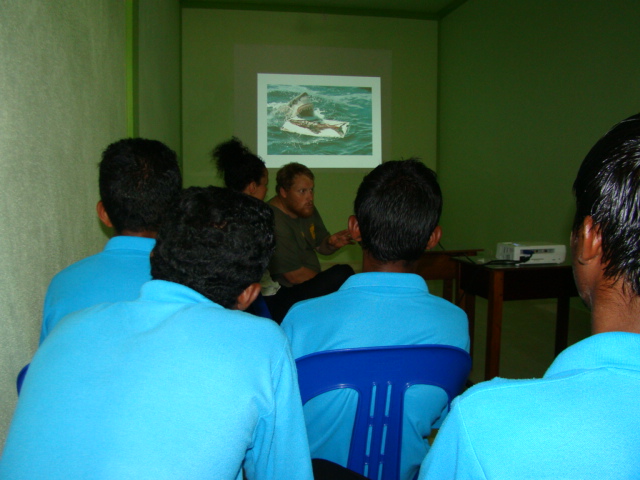
Soneva Fushi welcomed Captain Mike Tan from Singapore who trained our water sports hosts in both theoretical and hands on standard procedures for catch and release to increase the chances of survival for the released fish, and also how best to explain to our guests the importance of releasing unsustainable fish.

This training will have an impact in our hosts individual communities as they are keen to pass on their knowledge to their islands nearby.

Finally caught a fish!

Dehooking

Quick pic!

...and release!


Wahoo revival

All in all, a great success for sustainable fishing in Baa Atoll, and a training program that was thoroughly enjoyed by all.

Launch of "Reef Rangers" after school club

Soneva Fushi Launches Reef Rangers After School Club at Maalhos

July 2011 marked the launch of the first of 12 Reef Rangers activity at neighbouring island Maalhos.  

Soneva Fushi’s marine biologist has put together a 12 week activity program for 10 high school students that are passionate about the marine environment and that are keen to learn more.

The program covers a range of marine themes from sustainable fishing, to marine protected areas, to waste management and permaculture, through a hands on approach and getting the students out onto the reef.

The program was launched by extreme artists ‘olly and suzi’ who worked with the students, inspiring them about the nature of island ecosystems through art and introducing the plight of the manta rays. The sandy beach at Maalhos underneath the shady palms created a perfect setting for this first activity.


A Ray of Hope

British artists ‘olly and suzi’ highlight the plight of the manta ray and whale sharks

We all love the manta ray. This beautiful creature, so graceful and peaceful in its natural habitat, is one of the great sights of our oceans. But the manta ray is one of a number of species that is threatened by extinction. If we are to save these remarkable animals from extinction we need to highlight their plight.  British artists ‘olly and suzi’ visited Soneva Fushi in July to do exactly that. Since 1993 they have taken part in more than 50 expeditions to remote regions of the earth to paint predators and their prey at close proximity, before exhibiting their collaborative work in galleries such as the Simon Dickinson
Gallery in New York, and the Natural History
Museum in London.

Working closely with the marine biologist and Soleni Dive Centre, ‘olly and suzi’ painted the manta rays, as part of their campaign to highlight the plight of such threatened animals. They have visited the North Pole to paint polar bears, South Africa to paint great white sharks, the Galapagos to paint whale sharks, Africa to paint wild dogs, Cayman Islands to paint sting rays… and now Maldives to paint manta rays.   This was no normal painting –they actually painted the manta rays whilst underwater.

During their stay, ‘olly and suzi’ visited neighboring island Maalhos to teach high school students about the plight of manta rays, and how to work collaboratively, using nature to create some incredible art work.

Producer of “End of the Line” and cofounder of Blue Marine Foundation George Duffield accompanied ‘olly and suzi’ to photo document their journey and to produce images for their campaign to highlight the plight of these threatened animals.
The artwork will be exhibited in 2012 and 30% of the sales will be given to Blue Marine Foundation, a new charity formed by a group of influential individuals, brands and organisations to protect the world's oceans through the establishment of a global network of marine reserves. Six Senses' Maldivian resorts – Soneva Fushi, Soneva Gili and recently launched Six Senses Laamu – are sponsoring the foundation for the next three years.